
Research Overview
Streaming video over wireless networks must balance picture quality against available throughput, delays and transmission errors. Scalable video compression divides each sequence into a base layer and one or more enhancement layers. A receiver can decode the base layer when network capacity is limited and reconstruct progressively higher-quality video when additional layers are received.
Our research investigates layered video transmission, inter-layer forward-error correction (FEC), unequal error protection, hybrid automatic repeat request (HARQ), distributed multi-view video coding and iterative source–channel decoding. These techniques address the different importance of layers and the vulnerability of video streams to errors in wireless links.
Layered Video Compression
The base layer (BL), labelled L0, is the essential part of the transmitted sequence. Enhancement layers (ELs), such as L1, L2 and L3, depend upon the base layer and may also depend upon earlier enhancement layers. If the base layer is lost or corrupted, the dependent enhancement layers cannot be decoded. A lost intermediate enhancement layer can similarly make later layers unusable even if those later layers arrive successfully.
The original illustration compares several receiver types and transmission rates. With L0 at 128 kbit/s, the receiver can reconstruct quarter common intermediate format (QCIF) video at 7.5 frames per second. When L0, L1 and L2 are available, the receiver can reconstruct common intermediate format (CIF) video at 30 frames per second; the layer rates shown are 128, 256 and 512 kbit/s, respectively. Adding L3 provides a further quality improvement suitable for a larger television display.
Different devices—including mobile phones, tablets, computers and televisions—have different display requirements. Scalable coding therefore allows a common stream to serve multiple devices and different available bandwidths. Because lower layers are particularly important to reconstruction, robust transmission benefits from careful layer-aware error protection.
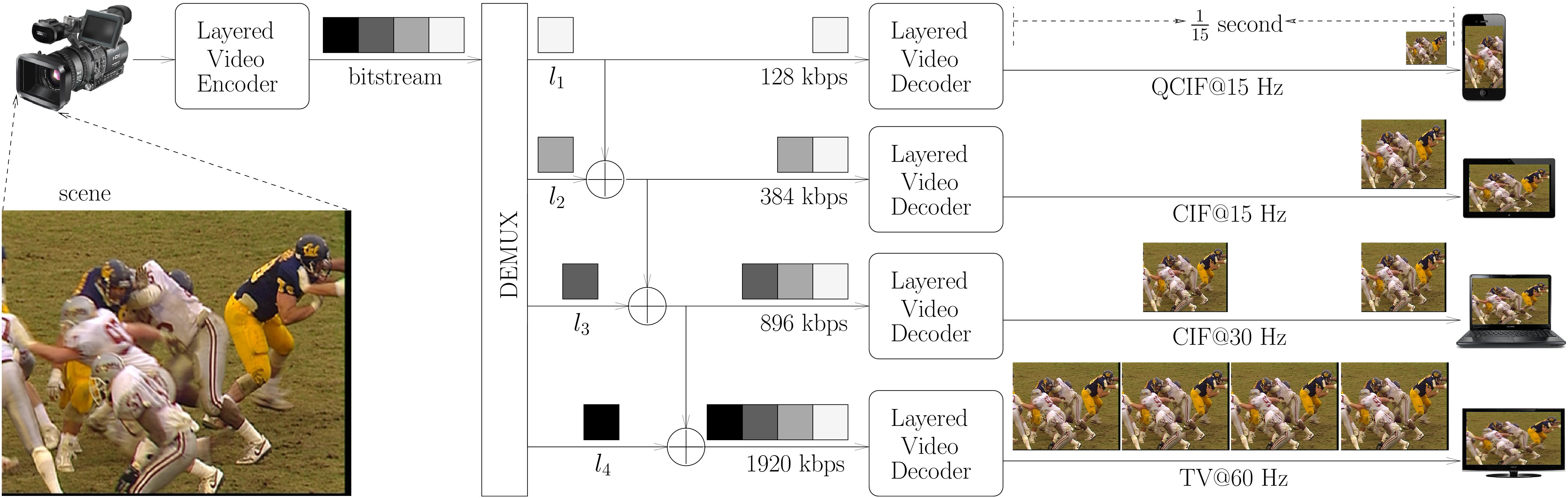
Figure 1. Scalable video transmission using a base layer and enhancement layers for different display sizes and quality levels.
Research Demonstrations
The original research programme paired several journal publications with demonstration pages covering layered video coding, inter-layer FEC, distributed video coding and iterative decoding. The publication list below provides the corresponding Paper and Demo references, retaining the nine original entries in their original order.
Journal Publications
The following bibliography is based on the original research page. It covers adaptive truncated HARQ, inter-layer FEC, multi-view video correlation models, unequal error protection and iterative source–channel decoding.
Adaptive Truncated HARQ Aided Layered Video Streaming Relying on Inter-Layer FEC Coding
A Tutorial and Review on Inter-Layer FEC Coded Layered Video Streaming
Wireless Video: An Interlayer Error-Protection-Aided Multilayer Approach
Motion-Aware Mesh-Structured Trellis for Correlation Modelling Aided Distributed Multi-View Video Coding
Two-Dimensional Iterative Source-Channel Decoding for Distributed Video Coding
Layered Wireless Video Telephony Relying on Minimum Distortion Inter-Layer FEC Coding
Inter-Layer FEC Aided Unequal Error Protection for Multi-Layer Video Transmission in Mobile TV
Iterative Source and Channel Decoding Relying on Correlation Modelling for Wireless Video Transmission
Spatio-Temporal Iterative Source-Channel Decoding Aided Video Transmission
Research papers and demonstrations remain subject to the copyright conditions of their authors and publishers.