Dynamic channel allocation, ad hoc networks and mobile social networking aided content dissemination.
Research Overview
Wireless networking research within the group has examined cellular network capacity, infrastructure-free mobile networks and the dissemination of information across combined cellular and opportunistic networks. The work connects wireless propagation and interference with resource allocation, cooperation, mobility and social relationships.
Dynamic Channel Allocation Research
Professor Lajos Hanzo and Dr Jonathan Blogh
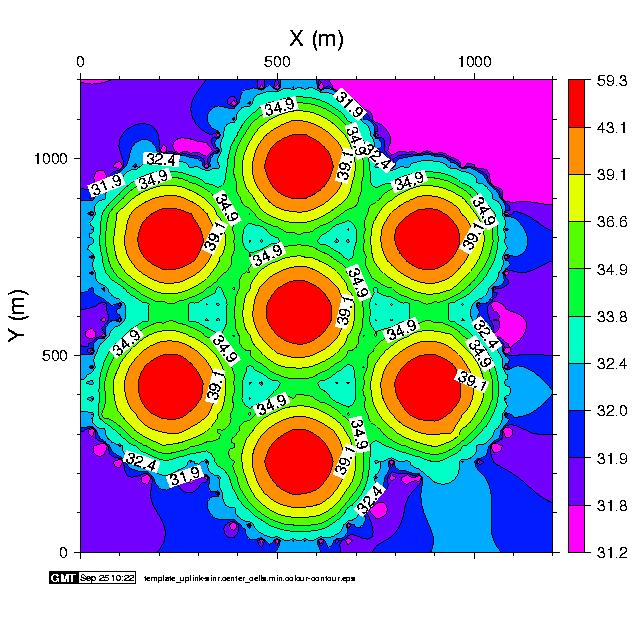
This research investigated the capacity and performance of GSM cellular networks using fixed and dynamic channel allocation. Because co-channel interference limits cellular performance, the studies examined adaptive antenna arrays at base stations as a means of reducing interference.
Power control was investigated both independently and in combination with adaptive modulation. Power control can lower the transmission power required by mobile stations, potentially extending battery life and improving network performance. Combining power control with adaptive modulation can provide further improvements in modem throughput.
The original work also considered the capacity and performance of CDMA-based UMTS cellular networks. References to UMTS as a forthcoming technology in the historical source reflect the period in which that research description was written.
Historical figure unavailable locally: PGpic.jpg
Figure 1. Minimum uplink SINR for the seven centre cells of a GSM cellular network.
Ad Hoc Wireless Networks
Professor Lajos Hanzo and Kin C. Yong
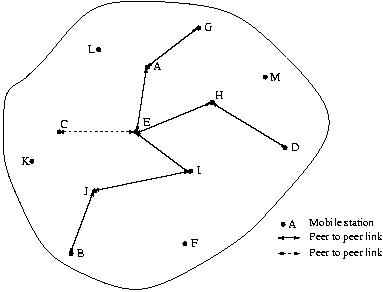
An ad hoc wireless network is a collection of mobile nodes that communicate without fixed base-station infrastructure. Each station can act as a relay, enabling peer-to-peer communication over temporary multi-hop routes formed as needed.
This architecture supports rapid deployment where communications infrastructure is unavailable or impractical. The research considered the resulting networking behaviour, including teletraffic performance evaluated through computer simulation.
Figure 2. Example of an ad hoc network with routes B–J–I–E–A–G and C–E–H–D.
Mobile Social Networking Aided Content Dissemination in Heterogeneous Networks
Professor Lajos Hanzo, Professor Lie-Liang Yang and Dr Jie Hu
Distributed Cooperative Social Multicast
In this approach, mobile stations seeking the same content form a self-organising network. After receiving the content, a station can become a content owner and relay it to other unserved stations with which it has a social relationship. Content delivery depends on both the social connection and the conditions of the wireless link.
The analysis combines geographical social strength, propagation path loss and small-scale fading to characterise social unicast throughput. A discrete-time pure-birth Markov-chain model is used to study content-dissemination delay. The original study reports that, under sufficiently high mobile-station density, the protocol can deliver the requested content to all stations within two transmission frames in its analysed setting.
Multistage cooperative social multicast: receivers become additional content owners.
Integrated Cellular and Opportunistic Networks
Conventional cellular infrastructure may be inefficient when many users request the same information of common interest. Opportunistic device-to-device links can supplement cellular connectivity, enable traffic offloading and support information dissemination through direct encounters between mobile users.
The source research examines large-scale opportunistic networking using social network analysis and inter-contact/contact durations. Its models include continuous-time pure-birth Markov chains. In the original reported evaluations, an opportunistic network of 20 mobile users achieved a delivery ratio exceeding 90% under the stated conditions; experiments using the InfoCom 2006 mobility trace reported cellular teletraffic offloading of 58%.
Applications of integrated cellular and opportunistic networks: coverage extension and traffic offloading.
Hybrid Multicast and Cooperative Dissemination
For smaller opportunistic networks, a hybrid scheme combines an initial base-station-assisted multicast stage with a subsequent cooperative multicast stage among mobile stations. The analysis takes account of mobility, wireless fading and resource scheduling, with discrete-time pure-birth Markov-chain modelling.
According to the source research, the hybrid design improved delay performance while consuming less energy than the conventional base-station-assisted single-hop multicast benchmark in the evaluated scenarios.

Mobile Social Networking Aided Content Dissemination in Heterogeneous Networks
Professor Lajos Hanzo, Professor Lie-Liang Yang and Dr Jie Hu
Distributed Cooperative Social Multicast
In this approach, mobile stations seeking the same content form a self-organising network. After receiving the content, a station can become a content owner and relay it to other unserved stations with which it has a social relationship. Content delivery depends on both the social connection and the conditions of the wireless link.
The analysis combines geographical social strength, propagation path loss and small-scale fading to characterise social unicast throughput. A discrete-time pure-birth Markov-chain model is used to study content-dissemination delay. The original study reports that, under sufficiently high mobile-station density, the protocol can deliver the requested content to all stations within two transmission frames in its analysed setting.
MulticastExample.jpgMultistageProtocol.jpgIntegrated Cellular and Opportunistic Networks
Conventional cellular infrastructure may be inefficient when many users request the same information of common interest. Opportunistic device-to-device links can supplement cellular connectivity, enable traffic offloading and support information dissemination through direct encounters between mobile users.
The source research examines large-scale opportunistic networking using social network analysis and inter-contact/contact durations. Its models include continuous-time pure-birth Markov chains. In the original reported evaluations, an opportunistic network of 20 mobile users achieved a delivery ratio exceeding 90% under the stated conditions; experiments using the InfoCom 2006 mobility trace reported cellular teletraffic offloading of 58%.
ExtendingCoverage.jpgHybrid Multicast and Cooperative Dissemination
For smaller opportunistic networks, a hybrid scheme combines an initial base-station-assisted multicast stage with a subsequent cooperative multicast stage among mobile stations. The analysis takes account of mobility, wireless fading and resource scheduling, with discrete-time pure-birth Markov-chain modelling.
According to the source research, the hybrid design improved delay performance while consuming less energy than the conventional base-station-assisted single-hop multicast benchmark in the evaluated scenarios.
FrameAndArchitecture.jpgVideo Demonstration: Social-Network-Aided Information Dissemination
Watch the demonstration of information dissemination in integrated cellular and opportunistic wireless networks.