
Research Overview
Optical wireless systems use light rather than radio-frequency carriers to transmit information. This research programme investigates visible-light communication (VLC), free-space optical links and optical fibre systems, with particular emphasis on resource allocation, waveform design, forward error correction and receiver algorithms.
The five research themes below connect network-level user association and heterogeneous access with intensity-modulated optical transmission, layered optical OFDM, experimentally verified coding schemes and machine-learning-assisted transceivers.
User-Centric Visible Light Communication Networks
Researchers: Prof. Lajos Hanzo, Dr Rong Zhang, Dr Xuan Li and Dr Simeng Feng
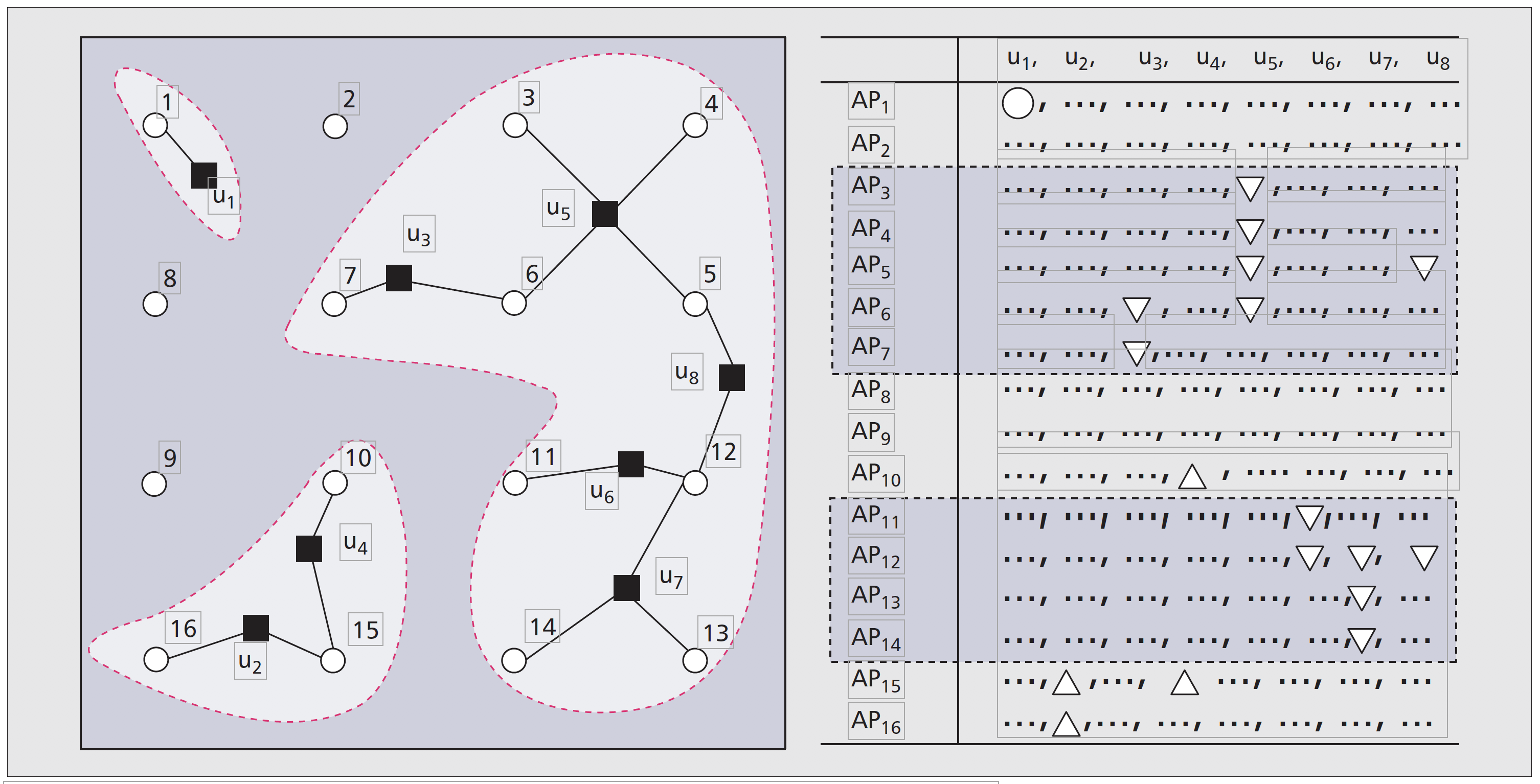
In user-centric VLC, optical access points are grouped around the requirements and location of each receiver, rather than operating as fixed, network-centric cells. These amorphous access-point clusters support vectored transmission and can adjust as users move. Cluster selection and interference management are considered together with the quality of service experienced by individual users.
The research also examines energy-aware delivery of scalable video. Modulation selection, access-point power allocation and cluster configuration can be coordinated to balance picture quality, throughput and energy consumption. The demonstrations compare the reconstructed video and per-frame peak signal-to-noise ratio of user-centric clusters with conventional universal frequency reuse.
Video Demonstration: User-Centric VLC for Scalable Video Streaming
This demonstration compares the original video and reconstructed outputs under user-centric clustering and universal frequency reuse, illustrating cluster membership and video quality for a moving user.
Selected Publications
- Visible Light Communications in Heterogeneous Networks: Pave the Way for User-Centric Design
- Users First: User-Centric Cluster Formation for Interference Mitigation in Visible Light Networks
- Energy Efficient Visible Light Communications Relying on Amorphous Cells
- User-Centric Visible Light Communications for Energy-Efficient Scalable Video Streaming
- Hybrid Positioning for the Amorphous-Cell Assisted User-Centric Visible Light Downlink
VLC-Aided Heterogeneous Networks
Researchers: Prof. Lajos Hanzo, Dr Rong Zhang, Dr Xuan Li, Dr Fan Jin, Dr Junyi Jiang, Dr Yongkai Huo and Dr Chuan Zhu
Visible-light access can complement Wi-Fi and other radio-frequency links. The radio network provides widespread connectivity, while LED-based optical access points can deliver high data rates in illuminated indoor areas. This approach combines the available optical spectrum with existing wireless-network coverage.
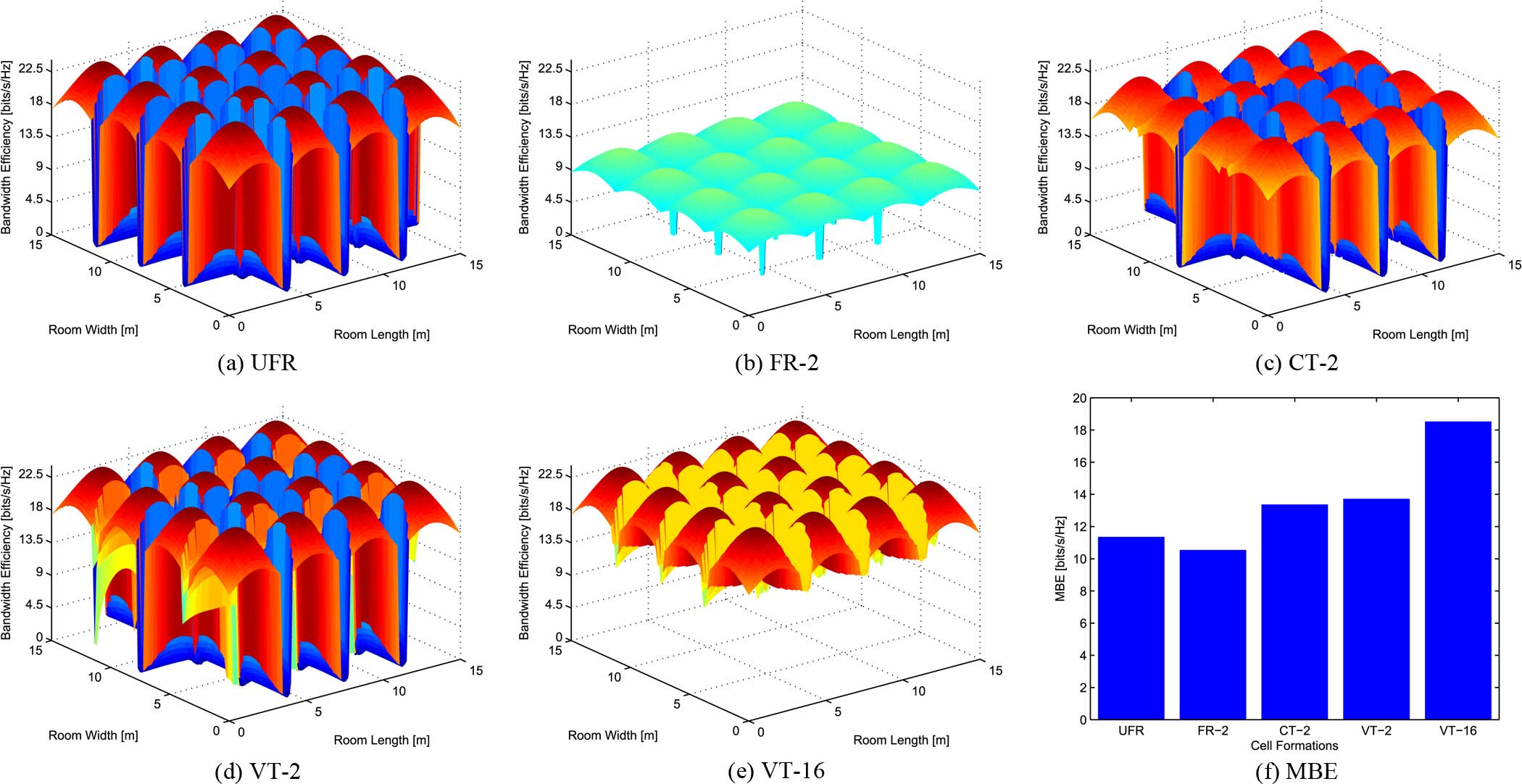
The research compares conventional frequency-reuse cells with jointly transmitting or vectored access points. Centralised and distributed load-balancing algorithms seek fairer allocation between optical and radio links, while evaluating area spectral efficiency and aggregate throughput. Delay constraints and indoor multiuser video delivery are also examined.
Selected Publications
Physical-Layer Techniques for Visible Light and Free-Space Optical Communications
Researchers: Prof. Lajos Hanzo, Prof. Sheng Chen, Dr Rong Zhang, Dr Junyi Jiang, Dr Zunaira Babar and Dr Qi Wang
Visible-light transmitters frequently use intensity modulation and direct detection (IM/DD): information is conveyed by changes in emitted optical power and recovered by photodetection. This places constraints on optical waveforms that differ from conventional complex-valued radio signals. Practical designs must also account for illumination, dimming and flicker.
Research topics include on–off keying, pulse-position modulation, photon-counting detection, colour-shift keying, generalised colour modulation, optical CDMA and optical OFDM. Receiver-side predistortion, iterative interference cancellation, adaptive biasing and aperture selection address distortion, noise or turbulence under different optical channel conditions.
Optical OFDM variants include asymmetrically clipped OFDM (ACO-OFDM), DC-biased optical OFDM (DCO-OFDM) and layered ACO-OFDM (LACO-OFDM). Layering allows several signal components to share the available subcarriers, with interference cancellation at the receiver. The original research illustrates a layered time-domain waveform and its constituent layers using 32 subcarriers.
Further work on colour-shift keying considers non-binary and iterative detection, coding and signal-labelling strategies, together with hierarchical modulation for video transmission over visible-light links.
Selected Publications
- A Photon-Counting Spatial-Diversity-and-Multiplexing MIMO Scheme for Poisson Atmospheric Channels Relying on Q-ary PPM
- Multi-Layer Modulation for Intensity-Modulated Direct-Detection Optical OFDM
- Enhancing the Decoding Performance of Optical Wireless Communication Systems Using Receiver-Side Predistortion
- Chip-Interleaved Optical Code Division Multiple Access Relying on a Photon-Counting Iterative Successive Interference Canceller for Free-Space Optical Channels
- Performance and Capacity Analysis of Poisson Photon-Counting Based Iter-PIC OCDMA Systems
- An Adaptive Scaling and Biasing Scheme for OFDM-Based Visible Light Communication Systems
- Analysis and Design of Three-Stage Concatenated Color-Shift Keying
- Reduced-Complexity Iterative Receiver for Improving the IEEE 802.15.7 Convolutional-Coded Color Shift Keying Mode
- Hierarchical Colour-Shift-Keying Aided Layered Video Streaming for the Visible Light Downlink
- Aperture Selection for ACO-OFDM in Free-Space Optical Turbulence Channel
- Performance Analysis of Layered ACO-OFDM
- On the Discrete-Input Continuous-Output Memoryless Channel Capacity of Layered ACO-OFDM
- The Evolution of Optical OFDM
Forward Error Correction in Optical Wireless and Fibre Optical Communications
Researchers: Prof. Lajos Hanzo, Prof. Sheng Chen, Dr Zunaira Babar and Dr Xiaoyu Zhang
Coding research for LACO-OFDM exploits the layered waveform structure to protect different information streams. Multi-class channel coding combines coded and uncoded soft information for inter-layer interference cancellation, iterative symbol detection and improved error-rate performance. The performance–complexity trade-off is assessed using achievable-rate analysis and simulations.
For one four-layer, 16-QAM LACO-OFDM configuration, the reported study approached its achievable rate within approximately 1.1 dB at a bit-error ratio of 10⁻³ and improved upon the comparison scheme by around 3.6 dB. A related multilayer coding design reported operation within about 2 dB of the modelled capacity limit at a BER of 10⁻⁴.
The programme also includes adaptive bit loading and laboratory demonstrations. Reported optical-fibre experiments examined transmission over links up to 20 km and rates up to 72 Gb/s in the stated test configurations. A separate fibre–wireless–fibre study evaluated how channel coding mitigates alignment errors in free-space optical links, reporting improved tolerance relative to an uncoded link.
The original research also compares throughput against signal-to-noise ratio for the individual layers of a two-layer LACO-OFDM system operating over a 10-km optical-fibre channel.
Selected Publications
- Multi-Class Coded Layered Asymmetrically Clipped Optical OFDM
- Near-Capacity Multilayered Code Design for LACO-OFDM-Aided Optical Wireless Systems
- High-Speed Multi-Layer Coded Adaptive LACO-OFDM and Its Experimental Verification
- Experimental Characterization of Turbo-Coded 20 Gbps Fiber-Wireless-Fiber Optical Links
Artificial-Intelligence-Aided Optical Communications
Researchers: Prof. Lajos Hanzo, Dr Tien V. Luong and Dr Xiaoyu Zhang
Machine learning offers an alternative way to design optical OFDM signals for IM/DD systems. The OOFDMNet proposal uses deep neural networks to map conventional complex-valued OFDM symbols into non-negative optical transmit signals and recover them at the receiver, while retaining frequency-domain processing.
The neural-network pair is trained end to end as an autoencoder. In the reported simulations, the approach reduces bit-error ratio and peak-to-average power ratio compared with selected optical-OFDM benchmarks, at the expense of additional neural-network processing. The study also investigates integration with soft-decision channel decoding using convolutional and polar codes, and discusses the feasibility of real-time operation.
Selected Publications
- Deep Learning-Aided Optical IM/DD OFDM Approaches the Throughput of RF-OFDM