
Research Overview
Multiple-input multiple-output (MIMO) communication exploits several antenna elements for improved reliability, additional parallel data streams and interference suppression. The original research programme distinguishes diversity coding, spatial multiplexing, beamforming and systems that combine these functions.
The work examines coherent and differential designs, spatial modulation, space–time shift keying (STSK), multicarrier transmission, channel estimation, precoding and distributed multi-cell antenna architectures.
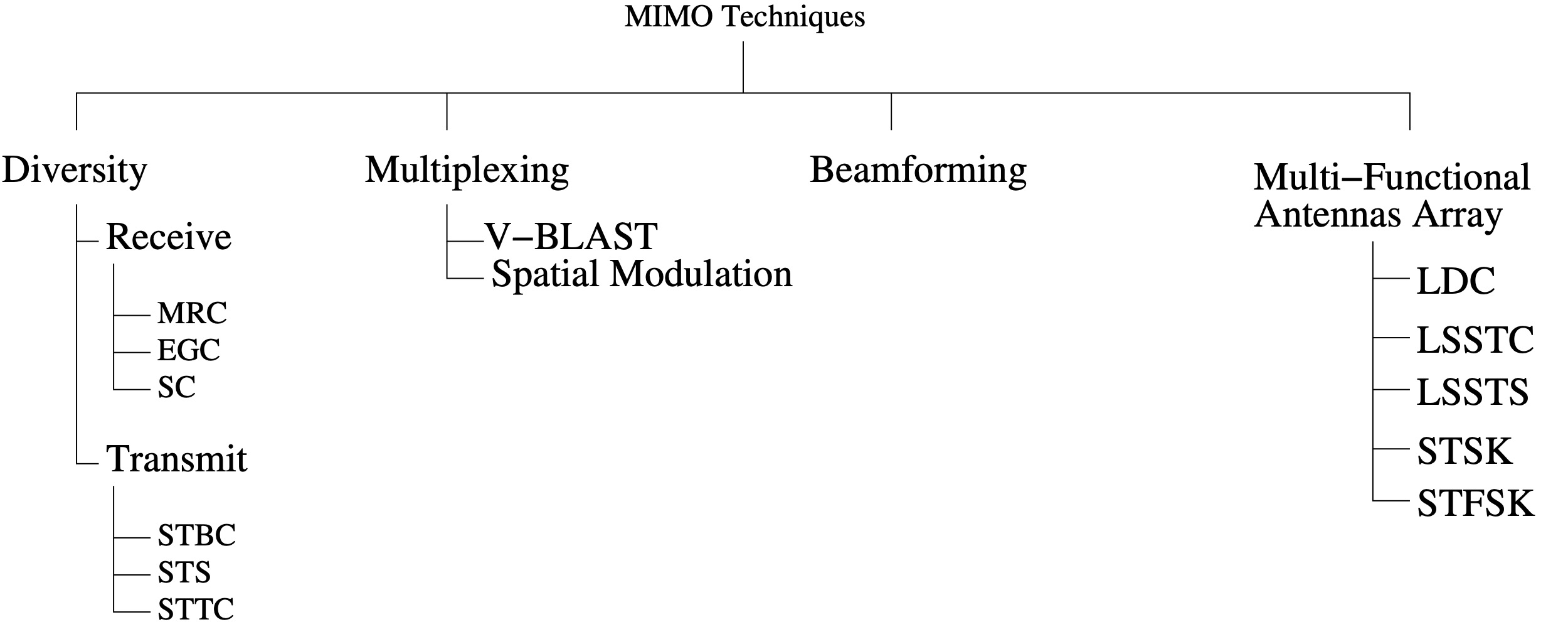
Classification of MIMO Techniques
Space–time block and trellis codes primarily improve fading resilience; layered architectures such as V-BLAST use simultaneous spatial streams to raise throughput. Space-division multiple access separates users through their distinct channel responses, while directional beamforming can suppress interference. Multifunctional arrangements pursue several of these gains together.
Selected Publications and Resources
- Near-Capacity Wireless Transceivers and Cooperative Communications in the MIMO Era: Evolution of Standards, Waveform Design, and Future Perspectives
- A Universal Space-Time Architecture for Multiple-Antenna Aided Systems
- MIMO-Aided Near-Capacity Turbo Transceivers: Taxonomy and Performance versus Complexity
Multifunctional MIMO: Spatial Division Multiplexing / Multiple Access, Space Time Coding and Beamforming
Trifunctional transceivers integrate space–time spreading for diversity, layered signalling for multiplexing and beamforming for directionality. Time- and frequency-domain spreading supports multiple users, while grouping and iterative decoding can alleviate interference and improve convergence.
Selected Publications and Resources
- Layered Steered Space–Time-Spreading-Aided Generalized MC DS-CDMA
- Layered Steered Space-Time Codes Using Multi-Dimensional Sphere Packing Modulation
Differential MIMO: Differential Space Time Coding, Linear Dispersion Code, Space Time Shift Keying
Differential space–time transmission offers alternatives when channel state information is costly to obtain. Linear dispersion codes allow flexible rate–diversity trade-offs, while irregular precoding and EXIT-chart-guided serial concatenation are studied as means of approaching MIMO capacity over a range of signal-to-noise ratios.
Selected Publications and Resources
- Near-Capacity Irregular-Convolutional-Coding-Aided Irregular Precoded Linear Dispersion Codes
- Coherent and Differential Space-Time Shift-Keying: A Dispersion Matrix Approach
Additional Publications and Historical Demonstrations
- Generalised Space-Time Shift Keying Designed for Flexible Diversity, Multiplexing and Complexity Tradeoffs
Low-Complexity Spatial Modulation and Space-Time Shift Keying
Spatial modulation conveys information through both a conventional modulation symbol and the index of the active transmit antenna. STSK generalises this idea by choosing a dispersion matrix and spreading a symbol across antennas and time slots. These approaches aim to reduce the search burden of full multi-stream maximum-likelihood detection.
Further Publications from the Original Research Page
- Spatial modulation and space-time shift keying: Optimal performance at reduced detection complexity
- Coherent and differential space-time shift keying: A dispersion matrix approach

V-BLAST and spatial modulation example

Space–time shift keying schematic
Multicarrier-Aided STSK Schemes
Multicarrier STSK combines the original space–time signalling with OFDM, MC-CDMA and OFDMA or SC-FDMA. These arrangements address frequency-selective propagation and multiuser access, and SC-FDMA variants are of particular interest when peak-to-average power ratio matters.

Multicarrier STSK transmitter and receiver

STSK transmission model

STSK receiver model
Additional Publications and Historical Demonstrations
- OFDMA/SC-FDMA aided space-time shift keying for dispersive multiuser scenarios
- Successive-relaying-aided decode-and-forward coherent versus noncoherent cooperative multicarrier space-time shift keying
- Iterative soft multiple-symbol differential sphere decoding aided multicarrier space-time shift keying
Channel Estimation for CSTSK Systems
For coherent STSK, the source investigates semi-blind channel estimation using a limited number of training blocks followed by decision-directed refinement. In more elaborate receivers, channel estimation operates within a three-stage iterative demapping and decoding structure, reducing the need for a separate estimation loop.
Further Publications from the Original Research Page
- Semi-blind joint channel estimation and data detection for space-time shift keying systems
- Reduced-complexity near-capacity joint channel estimation and three-stage turbo detection for coherent space-time shift keying

Coherent STSK channel-estimation receiver
Closed-Loop MIMO: Transmit Precoding and Limited Feedback
Closed-loop MIMO uses channel feedback to coordinate transmit precoders and receive detectors. Joint transmitter–receiver optimisation addresses interference and unequal channel quality, including limited feedback, singular-value-based designs and egocentric versus altruistic objectives in multiuser links.
Further Publications from the Original Research Page
- Joint Transmitter-Receiver Design in TDD Multiuser MIMO Systems: An Egocentric/Altruistic Optimization Approach
- SVD-Assisted Multiuser Transmitter and Multiuser Detector Design for MIMO Systems
Multi-Cell MIMO: Base-Station Cooperation and Optical Fiber Aided Distributed Antenna
Multi-cell MIMO extends the antenna-processing problem across coordinated base stations. Cooperation and fibre-connected distributed antenna systems can reduce inter-cell interference and improve coverage, while introducing signalling, synchronisation and backhaul requirements.
Additional Publications and Historical Demonstrations
- Distributed Downlink Multi-Cell Processing Requiring Reduced-Rate Back-haul Data Exchange
- Unified Bit-Based Probabilistic Data Association Aided MIMO Detection for High-Order QAM Constellations
- Imperfect Radio Over Fibre Aided Distributed Antennas with Fractional Frequency Reuse