Research Overview
Machine-to-machine (M2M) communication enables devices to exchange information and coordinate actions with limited human intervention. A typical system may connect sensors, actuators, utility meters, cameras, industrial controllers and mobile terminals. Communication requirements consequently extend far beyond those of conventional person-to-person mobile services.
The research challenge is to support large populations of connected devices without assuming that they share the same radio interface, processing capacity, traffic pattern or energy budget. Network design must jointly address access, interference, coverage, data delivery and the resources available to each device.
Our work studies the interaction between information theory, transceiver architectures, multiple-access techniques, resource management and routing. The objective is to create adaptable communication systems that can support large numbers of diverse devices while maintaining reliable service and efficient use of bandwidth and energy.
The Internet of Things
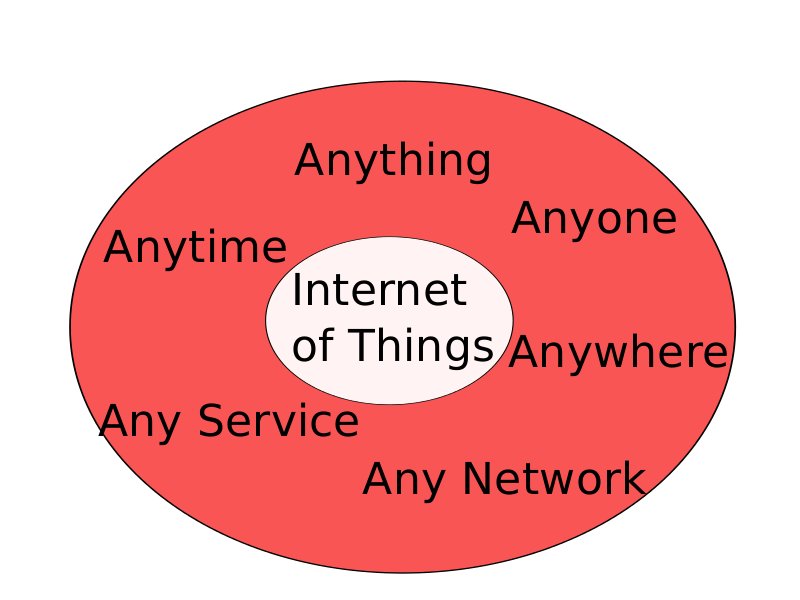
The Internet of Things (IoT) extends network connectivity to physical objects that sense, report, interpret or influence their environments. Connecting these objects provides a link between the physical world and digital services: measurements can inform decisions, and control messages can trigger action at remote locations.
IoT applications range from short, infrequent sensor reports and smart metering to bandwidth-intensive surveillance and multimedia transmission. Devices may communicate locally, through access networks, or over geographically extensive infrastructures. The resulting systems must accommodate both automatic sensing and time-sensitive control.
The early M2M research programme anticipated billions of devices and substantial growth in mobile-data traffic. Its historical discussion noted that connected things outnumbered connected people around 2009, and reported contemporary projections of 10–50 billion M2M devices by 2020. These were forecasts made at the time, not measurements of the eventual 2020 deployment.
The same research context cited Cisco forecasts of a thirteen-fold rise in global mobile data traffic from 2012 to 2017, reaching 11.2 exabytes per month, and an increase in average mobile connection speed from 526 kbit/s in 2012 to more than 3.9 Mbit/s in 2017. These historical figures illustrate why scalability and spectrum management became central research questions.
A long-term vision is connectivity across people, objects, services and locations, independent of whether the underlying links are wireless or wired. Realising this vision requires both the ability to exchange small amounts of control data and the capacity to transport continuous, high-rate information.

M2M Requirements and Heterogeneity
M2M devices are heterogeneous in their physical design and communication behaviour. A basic sensor may have little memory, limited computation and a battery intended to last for years. At the other extreme, a camera or industrial controller may require sustained throughput, substantial processing and low end-to-end latency.
The traffic may consist of occasional event-driven messages, periodic reports, near-continuous media streams or emergency alerts. Data rates can vary from a few kilobits per second to several megabits per second, and communication ranges may extend from a few metres to several kilometres. Some applications remain stationary; others operate in highly mobile environments.
Reliability and quality-of-service targets also differ. For example, a smart electricity meter may tolerate delay and intermittent transmission, whereas medical monitoring, safety alarms or control loops can require prompt and dependable delivery. A suitable network therefore needs service differentiation instead of treating every connected device as an ordinary mobile user.
Practical system design considers bandwidth, transmit power, energy consumption, memory, storage, antenna size, processing complexity, mobility and cost alongside latency and reliability. The number and density of connected objects introduce further challenges in device identification, signalling overhead, congestion and network scalability.
These requirements span many operating modes: point-to-point and broadcast exchange; synchronous and asynchronous access; single-hop and multi-hop transfer; and continuous or sporadic connectivity. A flexible M2M architecture must support them without overwhelming low-cost endpoints with complex protocol requirements.
Spectrum Efficiency and Heterogeneous Networks
Spectral efficiency on an individual communication link does not by itself determine how much traffic a densely deployed network can support. Area spectral efficiency (ASE), which measures carried information per unit bandwidth and geographical area, is particularly important when large numbers of devices share the same spectrum.
Increasing the number of conventional macrocell base stations can improve spatial reuse, but gains diminish when inter-cell interference becomes severe or suitable sites are costly and difficult to acquire. Small-cell deployment provides an alternative: heterogeneous cellular networks combine macro base stations with lower-power pico cells, femto cells and relay nodes.
This heterogeneous-network approach was incorporated into the LTE-Advanced research agenda to increase capacity and improve local coverage. It also creates new interference-management, association and resource-sharing problems, especially when devices have substantially different service requirements.
Established radio systems employ time-, frequency-, code- and orthogonal-frequency-division multiple access (TDMA, FDMA, CDMA and OFDMA). These mechanisms remain important foundations, but very dense M2M traffic calls for flexible scheduling and coordination across multiple domains. Simply extending traditional infrastructure without addressing signalling burden and interference can produce congestion.
Future solutions must therefore improve the use of available spectral and spatial resources while balancing per-user fairness, cell-edge coverage, energy consumption and latency. The challenge is not merely to raise peak throughput, but to serve a far larger and more varied population of communicating objects.
Resource Allocation and Multi-Antenna Techniques
Wireless systems can exploit degrees of freedom in time, frequency, space, code and transmitted power. Their joint allocation can provide diversity against fading, simultaneous transmission of multiple data streams, and suppression or management of interference. Choosing the appropriate combination depends on the terminals and their service demands.
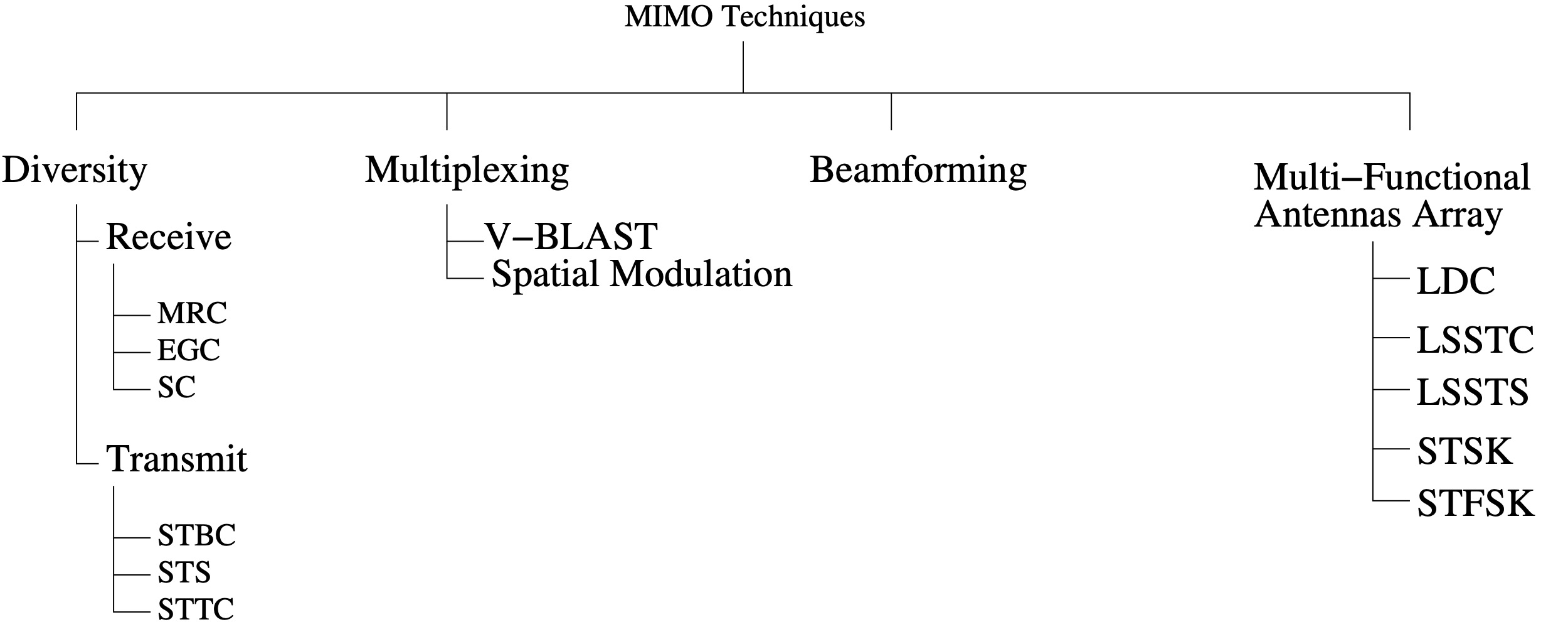
Our research investigates multi-functional antenna arrays and transceiver structures that combine spatial processing with frequency-, time- and code-domain operation. Such systems allow different trade-offs between multiplexing gain, diversity gain, throughput, detection complexity and robustness. They are particularly relevant to heterogeneous networks where channel conditions and device capabilities vary widely.
Receiver design is equally important. Interference-limited links may require iterative detection and decoding, sophisticated demodulation or lower-complexity detection architectures. Research on spatial modulation, space-time shift keying and space-time-frequency shift keying investigates how information may be conveyed through signal constellations and the activation of different spatial or temporal resources.
Resource-allocation policies must jointly consider available transmit power, achievable rates, latency, fairness and cell-edge service quality. They should adapt to traffic changes and interference without imposing unreasonable computation or signalling on simple sensor nodes.
The wider goal is a unified system design in which network-level decisions and physical-layer transceiver choices support one another, rather than being optimised independently. This is essential when systems combine many low-complexity devices with powerful infrastructure and diverse communication standards.
Direct Communication and Energy-Efficient Routing
Direct device-to-device exchange is an important M2M capability. It can allow neighbouring machines to communicate without passing every packet through a base station, potentially reducing infrastructure load, transmission delay and energy expenditure. However, direct links introduce substantial questions about how devices discover one another and maintain connectivity.
Routing depends on network topology, including the distribution and number of neighbours, link quality, mobility and the likelihood that a useful forwarding path is available. In very large networks, maintaining complete end-to-end route information can be impractical because the topology and traffic change too often.
Energy-aware routing must also take account of the remaining battery capacity of forwarding devices, not just the shortest path. Selecting a low-delay route may drain a small set of nodes quickly; spreading traffic can extend network lifetime, but may increase hop count or delivery delay. These are genuine multi-objective optimisation problems.
Cross-layer techniques use physical-link conditions, medium-access decisions and network-routing information together. Our research applies bio-inspired and evolutionary optimisation methods to dynamic network topologies, with objectives including lower energy dissipation, reduced end-to-end delay and longer operational lifetime.
The overarching challenge is to provide robust and scalable communication for a huge population of inexpensive devices that may have limited hardware, software and local intelligence. Routing, interference management and adaptation must therefore be designed for the capabilities of the devices rather than assuming ideal links or unlimited resources.
Research Publications
MIMO and foundational studies (7)
- Near-Capacity Multi-Functional MIMO Systems: Sphere-Packing, Iterative Detection and Cooperation (book, 2009)
- Near-Capacity Wireless Transceivers and Cooperative Communications in the MIMO Era: Evolution of Standards, Waveform Design, and Future Perspectives
- Wireless myths, realities, and futures: from 3G/4G to optical and quantum wireless
- Multifunctional MIMO systems: A combined diversity and multiplexing design perspective
- MIMO-aided near-capacity turbo transceivers: taxonomy and performance versus complexity
- Spatial Modulation for Generalized MIMO: Challenges, Opportunities and Implementation
- MIMO stochastic model and capacity evaluation of on-body channels
MIMO, relaying and space-time techniques (16)
- Pilot contamination elimination for large-scale multiple-antenna aided OFDM systems
- Opportunistic relay selection for co-operative relaying in cochannel interference contaminated networks
- Performance analysis of high-speed railway communication systems subjected to co-channel interference and channel estimation errors
- Detect-and-Forward Relaying Aided Cooperative Spatial Modulation for Wireless Networks
- Layered Steered Space–Time-Spreading-Aided Generalized MC DS-CDMA
- Layered steered space-time codes using multi-dimensional sphere packing modulation
- Downlink Steered Space-Time Spreading For Multi-Carrier Transmission Over Frequency Selective Channels
- Layered Steered Space-Time Codes and their capacity
- Coherent and Differential Downlink Space-Time Steering Aided Generalised Multicarrier DS-CDMA
- Area spectral efficiency of soft-decision space–time–frequency shift-keying-aided slow-frequency-hopping multiple access
- Soft-Demodulation of Space-Time-Frequency Shift Keying for Iterative Detection
- A universal space-time architecture for multiple-antenna aided systems
- Reduced-complexity iterative-detection aided generalized space-time shift keying
- Effects of Channel Estimation on Spatial Modulation
- Spatial modulation and space-time shift keying: optimal performance at a reduced detection complexity
- Generalised pre-coding aided spatial modulation
Energy efficiency, network design and routing (8)
- A Systematic Luby Transform Coded V-BLAST System
- Energy-efficient dynamic resource allocation for opportunistic-relaying-assisted SC-FDMA using turbo-equalizer-aided soft decode-and-forward
- Cross-layer aided energy-efficient opportunistic routing in ad hoc networks
- A spectrum leasing cooperative medium access protocol and its stability analysis
- Multi-objective routing optimization using evolutionary algorithms
- Achieving maximum energy-efficiency in multi-relay OFDMA cellular networks: a fractional programming approach
- Dynamic human behaviour based epidemic content dissemination in mobile social networks
- Energy-Conscious Turbo Decoder Design: A Joint Signal Processing and Transmit Energy Reduction Approach