Research Overview
Cooperative wireless communications exploit relay nodes, distributed coding and spectrum sharing to enhance connectivity, spectral efficiency and reliability. The six research themes below cover cognitive radio, two-way relaying, distributed turbo coding, multiple-access techniques, differential detection and physical-layer network coding.
Cooperative Cognitive Radio
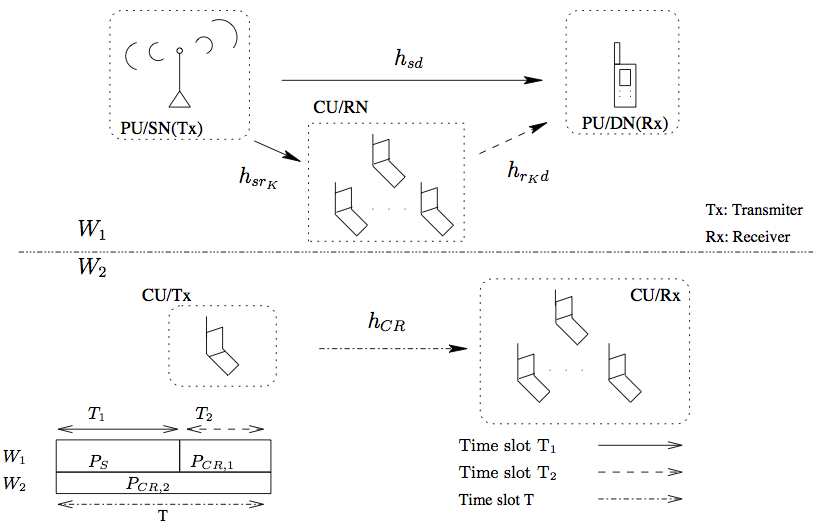
Cognitive radio systems identify spectrum opportunities not currently used by primary users, allowing secondary users to communicate while respecting primary-user access. The original research investigates active cooperation between primary and cognitive users, with the aim of improving transmission rates or reducing power consumption.
Adaptive Turbo Trellis Coded Modulation (ATTCM) adjusts the coding rate and modulation mode in response to channel conditions. Two-way relaying and adaptive coded modulation are considered jointly to improve the use of spectrum made available through cooperation.
Selected Publications
Two-Way Relaying for Cooperative Communications
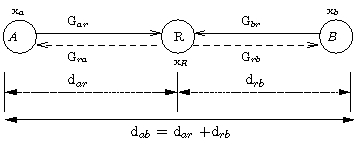
Conventional one-way relaying between two terminals via a relay can require four transmission time slots for a complete information exchange. Two-way relaying reduces this to two phases, improving spectral efficiency.
The original research combines joint source coding, channel coding and modulation with EXIT-chart analysis to study iterative-decoding convergence and transmission-power allocation. It also considers image transmission using low-complexity source coding and joint decoding.



Selected Publications
Distributed Turbo Coding Aided Cooperative Communications
By allowing distributed nodes to cooperate as a virtual antenna array, relaying can provide space–time diversity without requiring physically colocated antennas. This line of work adapts iterative and distributed turbo-coding concepts to cooperative communication systems.
It includes distributed turbo trellis-coded modulation, space–time codes, joint source-and-relay design under imperfect channels and three-stage iterative decoding. EXIT charts guide decoder convergence and near-capacity transceiver design.
Selected Publications
DS-CDMA and SC-FDMA Aided Cooperative Communications
Cooperative diversity improves reliability by exploiting signals forwarded by distributed terminals or relays. In multiuser systems, however, simultaneous relay transmissions may introduce multiple-access interference at receiving relays or the base station.
Direct-sequence CDMA is investigated for interference mitigation in cooperative systems, while single-carrier FDMA is considered for broadband links affected by frequency-selective fading. The research also examines allocation of power and channel-dependent relaying.
Selected Publications
- Single-User Performance of Direct-Sequence Code-Division Multiple-Access Using Relay Diversity and Power Allocation
- Transmitter-Preprocessing-Assisted Cooperative Downlink Transmission in DS-CDMA Systems Experiencing Propagation Path Loss and Nakagami Fading
- Power-Efficient Channel-Dependent Cooperative Relaying for the Multi-User SC-FDMA Uplink
Differential Cooperative Communications
Cooperative schemes can create distributed virtual MIMO links, but coherent detection normally needs channel estimation and pilot transmission. The training overhead and computational complexity can become substantial when many transmitters, receivers or relay links are involved.
Differential encoding and noncoherent detection offer an alternative that reduces reliance on explicit channel-state information. The source research includes differential sphere detection, vehicular ad hoc networking and time-resource allocation for cooperative relays.
Selected Publications
- The Amplify-and-Forward Cooperative Uplink Using Multiple-Symbol Differential Sphere-Detection
- Iterative Detection Assisted Cooperative Vehicular Ad Hoc Networking Using Differential Linear Dispersion Coding
- Optimum Time Resource Allocation for TDMA-Based Differential Decode-and-Forward Cooperative Systems: A Capacity Perspective
Multisource Cooperative Communications and Physical Layer Network Coding
Multiple source nodes may form a cooperating cluster that communicates with a destination over a cooperative multiple-access channel. The original work considers interleaved random space–time coding to improve reliability and throughput.
It compares superposition coding, which combines information from multiple sources in a composite signal, with physical-layer algebraic network coding (PANC). The aim is to improve energy efficiency and throughput in multisource cooperation.