
Research Overview
Channel coding and modulation aim to transmit information reliably and efficiently over noisy and fading channels. The research presented here covers iterative and concatenated coding, irregular codes and EXIT-chart design, LDPC and rateless codes, coded modulation and hierarchical modulation.
The five sections below follow the research topics and selected publications of the original Southampton Wireless Group page.
Turbo Code and Concatenated Code
Researchers: Prof Lajos Hanzo, Dr Soon Xin Ng, Dr Robert G. Maunder
Shannon established the fundamental limits of reliable communication in 1948. Turbo codes, introduced in 1993, made it possible to approach those limits using iterative decoding. They build on concatenated component codes and exploit the exchange of extrinsic information between decoders.
Research in this area investigates parallel and serial concatenation, convergence and termination of iterative decoding, and the use of turbo coding in wireless transmission and broadcasting. Turbo techniques have also been incorporated into practical mobile communication systems.
Selected Publications
Irregular Code and EXIT Chart Design
Researchers: Prof Lajos Hanzo, Dr Robert G. Maunder, Dr Soon Xin Ng, Dr Jing Wang
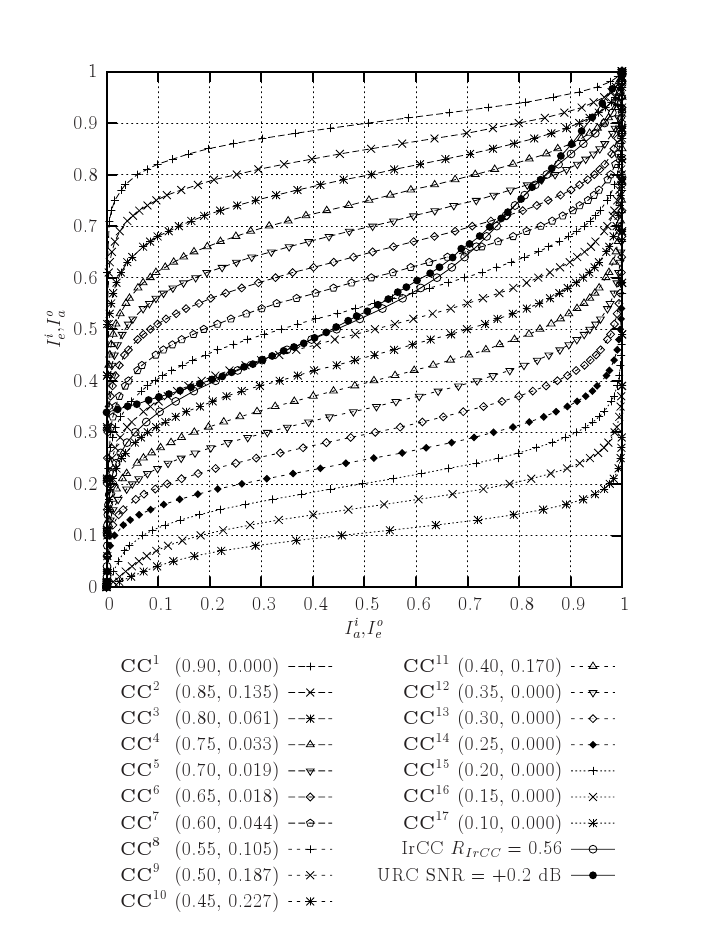
Irregular coding provides greater flexibility than regular codes by combining constituent codes or graph nodes of different degrees. In irregular LDPC codes, variable and check nodes can have differing numbers of connections, allowing code parameters to be optimised for operation close to channel capacity.
The same principle extends to irregular turbo codes, irregular convolutional codes (IrCCs) and irregular variable-length codes (IrVLCs). An EXIT chart describes the exchange of extrinsic information during iterative decoding. Component-code fractions can be selected to shape a composite EXIT curve and create an open decoding tunnel.
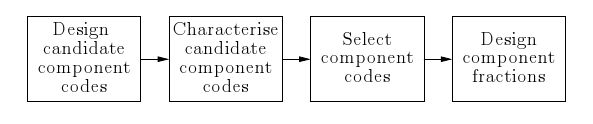
The original research describes a design process involving candidate component codes, characterisation of their EXIT functions and selection of component fractions. IrVLCs extend the approach to joint source and channel coding of non-uniformly distributed source symbols.
Selected Publications
LDPC Code, Rateless Code and Fountain Code
Researchers: Prof Lajos Hanzo, Dr Feng Guo, Dr Nicholas Bonello, Dr T. D. Nguyen, Mr Xin Zuo
Low-density parity-check (LDPC) and turbo codes are important practical approaches to the channel coding limits established by Shannon. Forward error correction adds structured redundancy to a transmitted message so that the receiver can detect and correct errors introduced by the channel.
LDPC codes use sparse parity-check constraints and iterative decoding, while rateless and fountain codes can generate additional encoded symbols as needed. This research investigates the design of these codes and their applications to adaptive and hybrid-ARQ transmission.
Selected Publications
Coded Modulation, Superposition Coded Modulation and Sphere Packing Modulation
Researchers: Prof Lajos Hanzo, Dr Soon Xin Ng, Dr Rong Zhang, Dr Osamah Alamri
Trellis-coded modulation (TCM) integrates error-correction coding with modulation without necessarily increasing the occupied bandwidth. Instead, redundancy is accommodated through an expanded signal constellation.
Combining turbo coding with TCM leads to turbo trellis-coded modulation (TTCM), whose iterative decoding can approach channel-capacity limits. Related work studies superposition-coded transmission, hybrid ARQ and nonbinary LDPC-coded sphere-packed diversity schemes.

Selected Publications
Turbo Trellis Coded Hierarchical Modulation
Researchers: Prof Lajos Hanzo, Dr Soon Xin Ng, Mr Hua Sun
Hierarchical modulation (HM), also called layered modulation, provides different levels of protection for simultaneously transmitted data streams. The original research investigates integrating hierarchical modulation with coding and cooperative relaying to improve throughput and power efficiency.
In the investigated scenario, a destination has limited direct reception capability over a fading channel. A relay-assisted turbo trellis-coded hierarchical modulation (TTCHM) arrangement allows higher-order constellations to be considered while maintaining acceptable bit-error-rate performance.
